Traditional Chinese Medicine and Periods: What Modern Science Confirms (and Doesn't)
Traditional Chinese Medicine (TCM) offers a holistic framework for understanding and balancing menstrual health, with modern science beginning to validate many of its ancient practices. While specific mechanisms are still being fully elucidated, research supports the efficacy of acupuncture and herbal medicine for conditions like period pain, PMS, and irregular cycles. This integrative approach focuses on restoring balance within the body's energy systems to alleviate menstrual discomfort and promote overall well-being.
Listen to this article
~20 min listen
Click play to generate audio narration with a calming voice
TL;DR Summary
- •TCM views menstrual health through the lens of Qi, Blood, and Organ balance, offering a holistic perspective on common period issues.
- •Acupuncture and specific Chinese herbal formulas are increasingly supported by modern research for alleviating period pain (dysmenorrhea), PMS symptoms, and regulating menstrual cycles.
- •While more rigorous, large-scale studies are needed, the growing body of evidence suggests that integrating TCM practices can be a valuable complementary approach for women's reproductive health.
Introduction
Traditional Chinese Medicine (TCM) provides a deeply rooted, holistic system for understanding and addressing women's menstrual health, often viewing symptoms like period pain, irregular cycles, and PMS not as isolated issues but as manifestations of deeper imbalances within the body's intricate energy systems. Modern science is increasingly turning its attention to these ancient practices, seeking to understand the physiological mechanisms behind their reported benefits and to validate their efficacy through contemporary research methodologies. This article will explore what modern science confirms—and where more research is needed—regarding the effectiveness of TCM for menstrual health, offering an integrative perspective on managing your period with Chinese medicine menstrual practices.
What Is Traditional Chinese Medicine (TCM) and How Does It Relate to Menstrual Health?
Traditional Chinese Medicine (TCM) is an ancient medical system that has been practiced for over 2,000 years, encompassing a wide range of practices including acupuncture, herbal medicine, dietary therapy, Tui Na (massage), and Qi Gong (mind-body exercises). At its core, TCM is based on the philosophy that the body's vital energy, or Qi (pronounced 'chee'), flows through specific pathways called meridians, and that illness arises when this flow is disrupted or imbalanced. For women's health, particularly concerning TCM periods, this intricate system focuses heavily on the balance of Qi and Blood, the health of specific organ systems (especially the Liver, Spleen, and Kidney), and the interplay of Yin and Yang energies.
In the context of menstrual health, TCM views the menstrual cycle as a delicate dance of Qi and Blood, influenced by these organ systems. For example, the Liver is responsible for the smooth flow of Qi and Blood, and stagnation in the Liver meridian can lead to symptoms like premenstrual irritability, breast tenderness, and painful periods. The Spleen governs the production of Qi and Blood and is crucial for digestion and nutrient absorption, meaning a weak Spleen can contribute to heavy bleeding or fatigue. The Kidneys are considered the root of reproductive health, storing essence (Jing) and governing the reproductive organs, influencing fertility and the regularity of cycles. Understanding these relationships is fundamental to how a TCM practitioner diagnoses and treats menstrual issues, aiming to restore harmony and balance rather than just suppressing symptoms.
How Does TCM Diagnose Menstrual Imbalances?
A TCM practitioner diagnoses menstrual imbalances through a comprehensive assessment that includes observing the tongue, feeling the pulse, and detailed questioning about symptoms, lifestyle, diet, and emotional state. This diagnostic process aims to identify specific patterns of disharmony. For instance, painful periods might be diagnosed as 'Blood Stagnation' if the pain is sharp and fixed, or 'Cold in the Uterus' if accompanied by a cold sensation and alleviated by warmth. Irregular cycles could be attributed to 'Liver Qi Stagnation' if stress-related, or 'Kidney Yin Deficiency' if accompanied by hot flashes and night sweats. This individualized approach is a hallmark of TCM and contrasts with a more generalized, symptom-focused Western medical diagnosis.
What Does Modern Science Confirm About Acupuncture for Period Pain and PMS?
Modern scientific research has increasingly focused on the mechanisms and efficacy of acupuncture, a key component of Chinese medicine menstrual practices, particularly for conditions like period pain (dysmenorrhea) and premenstrual syndrome (PMS). The evidence base for acupuncture period pain relief is growing, with numerous studies and meta-analyses suggesting its effectiveness.
Acupuncture for Dysmenorrhea (Period Pain)
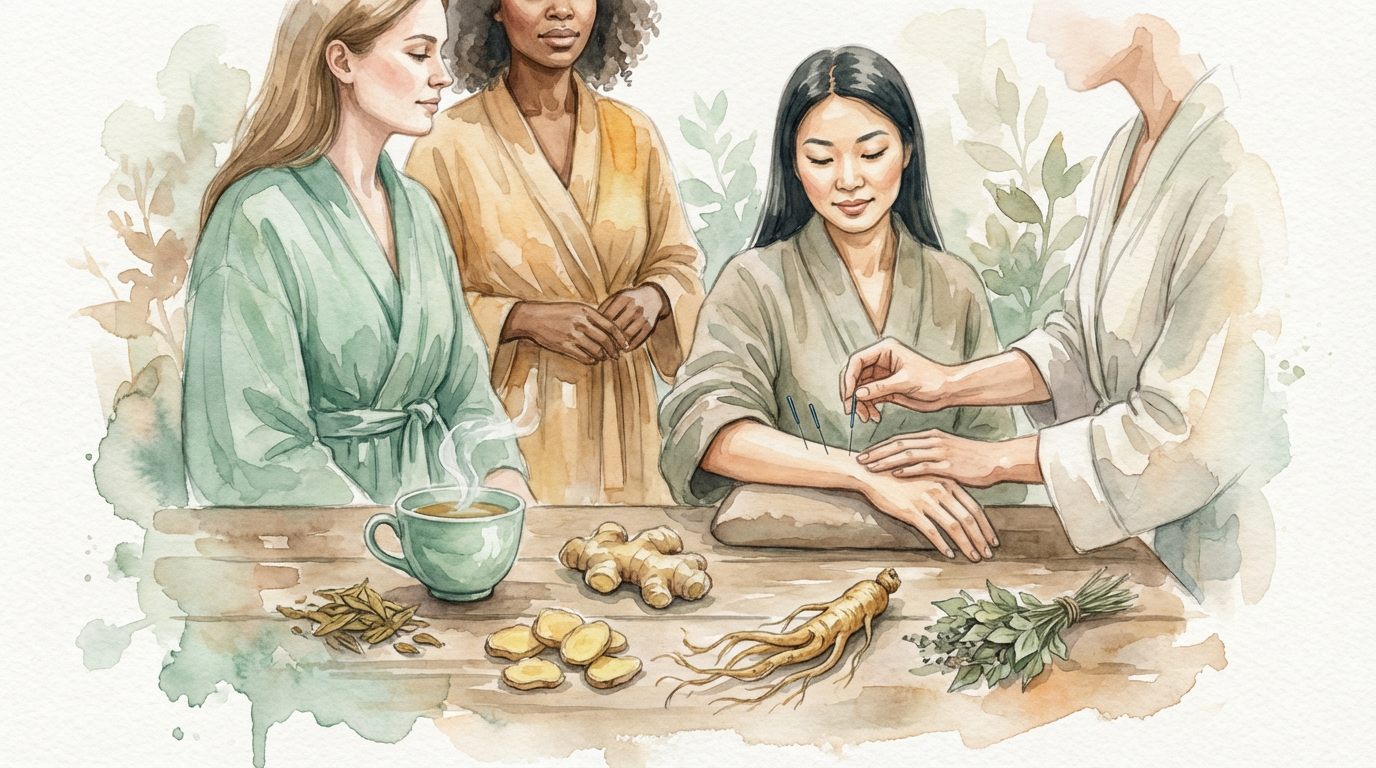
Acupuncture involves the insertion of thin needles into specific points on the body to stimulate Qi flow and promote healing. For primary dysmenorrhea (period pain not caused by an underlying condition), research largely supports acupuncture's ability to reduce pain intensity and duration. A 2016 systematic review and meta-analysis published in PLoS One found that acupuncture was effective in reducing menstrual pain and improving quality of life compared to no treatment or sham acupuncture. The proposed mechanisms include:
- •Endorphin Release: Acupuncture stimulates the release of endorphins, the body's natural painkillers, which can reduce the perception of pain.
- •Anti-inflammatory Effects: Studies suggest acupuncture can modulate inflammatory markers, reducing the prostaglandins that contribute to uterine contractions and pain.
- •Blood Flow Regulation: By influencing the nervous system, acupuncture may help regulate blood flow to the uterus, alleviating stagnation that often contributes to pain.
- •Neurotransmitter Modulation: Acupuncture can affect levels of neurotransmitters like serotonin and dopamine, impacting mood and pain perception.
While the exact physiological pathways are still being elucidated, the consistent findings across multiple studies provide strong support for acupuncture as a viable treatment option for period pain, often with fewer side effects than conventional pain medications.
Acupuncture for PMS Symptoms
Premenstrual Syndrome (PMS) encompasses a wide range of physical and emotional symptoms that occur in the luteal phase of the menstrual cycle. Research indicates that acupuncture can be beneficial in alleviating various PMS symptoms, including mood swings, irritability, breast tenderness, bloating, and fatigue. A review published in the Journal of Alternative and Complementary Medicine highlighted acupuncture's potential to regulate hormonal fluctuations, improve mood, and reduce physical discomfort associated with PMS. The mechanisms overlap with those for dysmenorrhea, including:
- •Hormonal Regulation: Acupuncture may influence the hypothalamic-pituitary-ovarian (HPO) axis, helping to balance estrogen and progesterone levels, which are often implicated in PMS.
- •Stress Reduction: By activating the parasympathetic nervous system, acupuncture can reduce stress and anxiety, common exacerbating factors for PMS.
- •Improved Sleep: Better sleep quality, often a challenge during PMS, can be a beneficial side effect of acupuncture treatment.
While more large-scale, high-quality randomized controlled trials are needed to standardize treatment protocols and fully understand the long-term effects, the existing evidence is promising for acupuncture as an integrative approach to managing PMS.
What Does Modern Science Confirm About Chinese Herbal Medicine for Menstrual Issues?
Chinese herbal medicine, another cornerstone of Chinese medicine menstrual practices, utilizes complex formulations of herbs tailored to an individual's specific diagnostic pattern. These formulas are designed to address the root cause of imbalances, not just the symptoms. Modern pharmacological research is actively investigating the active compounds within these herbs and their effects on the human body.
Herbal Medicine for Dysmenorrhea
Many traditional herbal formulas are used for period pain. For example, formulas containing herbs like Dang Gui (Angelica sinensis), Chuan Xiong (Ligusticum wallichii), and Shao Yao (Paeonia lactiflora) are commonly used to invigorate Blood, reduce stagnation, and alleviate pain. Scientific studies have begun to explore the mechanisms:
- •Anti-inflammatory Properties: Several Chinese herbs contain compounds with potent anti-inflammatory effects, similar to NSAIDs, which can reduce prostaglandin production and uterine cramping.
- •Analgesic Effects: Some herbs have direct pain-relieving properties, acting on pain pathways.
- •Uterine Relaxation: Certain herbs may help relax uterine muscles, reducing spasms that cause pain.
- •Improved Circulation: Herbs that 'move blood' can enhance uterine blood flow, preventing stagnation.
Meta-analyses, such as one published in Cochrane Database of Systematic Reviews, have concluded that Chinese herbal medicine may be effective for primary dysmenorrhea, often demonstrating comparable or superior effects to NSAIDs with fewer side effects. However, challenges remain in standardizing herbal preparations and conducting large, placebo-controlled trials due to the complexity of multi-herb formulas.
Herbal Medicine for Irregular Periods and PMS
For irregular periods, herbal formulas are chosen based on the underlying TCM pattern, aiming to regulate the menstrual cycle. For example, formulas addressing 'Liver Qi Stagnation' might include Chai Hu (Bupleurum) to smooth Qi flow, while those for 'Kidney Yin Deficiency' might feature Shu Di Huang (Rehmannia glutinosa) to nourish Yin. For PMS, herbs targeting emotional regulation, fluid balance, and breast tenderness are common.
- •Hormonal Modulation: Research suggests some Chinese herbs can exert estrogenic or anti-estrogenic effects, or influence the HPO axis, helping to normalize hormonal fluctuations that contribute to irregular cycles and PMS. For instance, Chasteberry (Vitex agnus-castus), though not strictly a Chinese herb, is often used in a similar functional context for PMS and has demonstrated effects on prolactin levels.
- •Neurotransmitter Support: Certain herbs contain compounds that can affect neurotransmitter levels, offering mood stabilization and reducing anxiety associated with PMS.
- •Diuretic Effects: Herbs like Ze Xie (Alisma) can help reduce fluid retention and bloating, common PMS symptoms.
While promising, the scientific validation of individual herbal components and complex formulas is an ongoing process. The synergistic effects of multiple herbs in a single formula make it challenging to isolate the impact of each component, requiring sophisticated research designs.
What Modern Science Doesn't Fully Confirm (Yet)
While the evidence for acupuncture period pain relief and herbal medicine for various menstrual issues is growing, there are areas where modern science is still catching up or requires more robust research.
- •Specific Mechanisms of Action: While theories exist, the precise molecular and cellular mechanisms by which many TCM treatments work are not always fully elucidated by Western scientific models. For example, the concept of 'Qi' is difficult to quantify with current biomedical tools.
- •Standardization and Quality Control: The quality and potency of Chinese herbal products can vary significantly, making it challenging to replicate research findings consistently. More rigorous standardization of herbal preparations is needed.
- •Large-Scale, High-Quality RCTs: While many studies exist, there is a continued need for more large-scale, double-blind, placebo-controlled randomized clinical trials (RCTs) to meet the highest standards of evidence-based medicine. The individualized nature of TCM treatment, where formulas are tailored to each patient, also presents a challenge for standardized trial designs.
- •Long-Term Efficacy and Safety: While short-term benefits are often observed, more research is needed on the long-term efficacy and safety of some TCM interventions, especially for chronic menstrual conditions.
- •Interaction with Western Medications: Research on potential interactions between Chinese herbal medicines and Western pharmaceuticals is still limited, necessitating careful supervision by qualified practitioners when combining treatments.
Benefits by Life Stage: Integrating TCM for Women's Reproductive Health
Menstrual Health (Periods, Cramps, PMS)
For general menstrual health, TCM offers a powerful framework for understanding and managing common complaints. By focusing on root causes rather than just symptoms, TCM aims to create a healthier, more balanced cycle. Regular acupuncture sessions can help regulate cycle length, reduce the intensity of period pain, and significantly diminish PMS symptoms like irritability, bloating, and breast tenderness. Herbal formulas are customized to address specific patterns like blood stagnation, qi deficiency, or liver qi stagnation, leading to smoother periods and improved overall well-being. Dietary adjustments, such as avoiding cold and raw foods during menstruation or incorporating warming spices, are also key components of TCM period care, supporting the body's natural processes.
Fertility Journey (TTC, Ovulation, Conception)
Chinese medicine menstrual practices are increasingly recognized as a valuable complementary therapy for women trying to conceive (TTC). TCM aims to optimize fertility by improving ovarian function, regulating ovulation, enhancing uterine blood flow, and reducing stress. Acupuncture has been shown to potentially improve success rates in IVF cycles by increasing blood flow to the uterus and ovaries, reducing uterine contractions, and alleviating stress. Herbal medicine can be used to address underlying imbalances that affect fertility, such as irregular ovulation, poor egg quality, or thin uterine lining. By supporting the body's natural ability to conceive, TCM offers a holistic approach to the fertility journey, often working in conjunction with Western reproductive technologies.
Pregnancy (Trimesters, Prenatal Care)
While certain herbs are contraindicated during pregnancy, acupuncture and specific dietary recommendations can be safely and effectively used throughout gestation. TCM can help manage common pregnancy discomforts such as morning sickness, fatigue, back pain, and anxiety. Acupuncture is particularly well-regarded for its ability to alleviate nausea and vomiting in early pregnancy. Later in pregnancy, it can help with sciatica, edema, and even prepare the body for labor by promoting cervical ripening and reducing labor duration. The focus during pregnancy is on nourishing the mother's Qi and Blood to support both her health and the healthy development of the baby, always under the guidance of a qualified practitioner experienced in prenatal care.
Menopause (Perimenopause, Hormonal Changes)
As women transition into perimenopause and menopause, TCM offers strategies to ease the associated symptoms, which can include hot flashes, night sweats, insomnia, mood swings, and vaginal dryness. In TCM, menopause is often viewed as a natural decline in Kidney Yin, leading to an imbalance of Yin and Yang. Acupuncture can help regulate the autonomic nervous system, reducing the frequency and intensity of hot flashes and improving sleep quality. Herbal formulas are tailored to nourish Kidney Yin, clear heat, and calm the spirit, using herbs like Rehmannia and Anemarrhena. Dietary and lifestyle adjustments, such as incorporating cooling foods and stress-reduction techniques, also play a crucial role in managing menopausal symptoms and promoting graceful aging.
Key Takeaways
- •TCM offers a holistic and individualized approach to women's menstrual health, addressing root causes of imbalance.
- •Acupuncture is scientifically supported for reducing period pain and various PMS symptoms by modulating pain, inflammation, and hormones.
- •Chinese herbal medicine shows promise in alleviating dysmenorrhea, regulating cycles, and managing PMS, with ongoing research into active compounds.
- •While more rigorous large-scale studies are continuously needed, the existing evidence supports the integration of TCM practices as complementary therapies.
- •TCM can benefit women across all life stages, from menstrual health and fertility to pregnancy and menopause, by restoring balance and promoting well-being.
Frequently Asked Questions
Q: Can TCM really help with severe period pain (dysmenorrhea)?
A: Yes, numerous studies and clinical experiences suggest that TCM, particularly acupuncture and specific herbal formulas, can significantly reduce the intensity and duration of severe period pain. It works by addressing underlying imbalances like blood stagnation and inflammation, often providing relief with fewer side effects than conventional pain medications.
Q: How long does it take for TCM to improve menstrual issues?
A: The timeline for improvement with TCM varies depending on the individual, the severity of the condition, and consistency of treatment. Some women experience relief within a few cycles, while chronic or more complex issues may require several months of consistent acupuncture, herbal medicine, and lifestyle adjustments. Your practitioner will provide a personalized treatment plan.
Q: Is Chinese herbal medicine safe to use with Western medications for menstrual health?
A: While many Chinese herbs are generally safe, potential interactions with Western medications can occur. It is crucial to inform your TCM practitioner about all medications and supplements you are taking. They can then formulate a safe and effective treatment plan, or advise on necessary monitoring or adjustments, working collaboratively with your Western medical doctor.
Q: What is the main difference between how Western medicine and TCM view periods?
A: Western medicine typically views periods and related issues through a biomedical lens, focusing on hormones, reproductive organs, and symptom management (e.g., pain relievers for cramps). TCM, conversely, sees the menstrual cycle as a reflection of the body's overall balance of Qi, Blood, Yin, and Yang, and the health of organ systems like the Liver, Spleen, and Kidney. It seeks to restore harmony to these energetic systems to resolve symptoms.
Q: Can TCM help with irregular menstrual cycles?
A: Absolutely. Regulating irregular menstrual cycles is one of the strengths of TCM. By diagnosing the specific pattern of imbalance (e.g., Liver Qi stagnation, Kidney deficiency, or Blood deficiency), TCM practitioners use acupuncture and customized herbal formulas to help normalize ovulation, balance hormones, and establish a more regular and healthy cycle.
Q: Are there any dietary recommendations in TCM for better period health?
A: Yes, dietary therapy is a key component of TCM for period health. General recommendations often include avoiding excessive cold and raw foods, especially during menstruation, as they can contribute to 'cold in the uterus' and worsen cramps. Emphasizing warm, cooked, nourishing foods, incorporating warming spices like ginger and cinnamon, and ensuring adequate iron-rich foods are common recommendations to support blood and qi.
Q: How does stress impact periods from a TCM perspective, and how can TCM help?
A: In TCM, stress is often linked to 'Liver Qi Stagnation,' as the Liver is responsible for the smooth flow of Qi throughout the body. Stagnant Liver Qi can disrupt the menstrual cycle, leading to irregular periods, PMS, and painful cramps. TCM addresses this through acupuncture points that soothe the Liver, herbal formulas that move Qi (e.g., Xiao Yao San), and lifestyle advice focused on stress reduction like Qi Gong or meditation, thereby promoting a smoother period experience.
Start Your Wellness Journey Today
Ready to track your cycle, fertility, pregnancy, or menopause journey? Download PERIODiQ - your iQ-powered wellness companion designed for every stage of your health journey.
Get PERIODiQ Free: https://periodiq.app
Your Wellness Journey Starts Here
Download PERIODiQ
Scan the QR code or tap the link to get started with your personalized health tracking.
periodiq.app • iOS & Android
Cite this article
PERIODiQ Editorial Team (2026). "Traditional Chinese Medicine and Periods: What Modern Science Confirms (and Doesn't)." PERIODiQ. https://periodiq.app/library/traditional-chinese-medicine-and-periods-what-modern-science-confirms-and-doesnt
"Traditional Chinese Medicine and Periods: What Modern Science Confirms (and Doesn't)." PERIODiQ, 2026, https://periodiq.app/library/traditional-chinese-medicine-and-periods-what-modern-science-confirms-and-doesnt.
Send this to a friend — PERIODiQ is free for them too. No card. No paywall.
Loved this? Save articles, track your cycle, and unlock meditations — free forever.
Disclaimer: PERIODiQ™ offers general wellness information only. It does not provide medical advice, diagnosis, or treatment. Always speak with a licensed health professional about your health.