
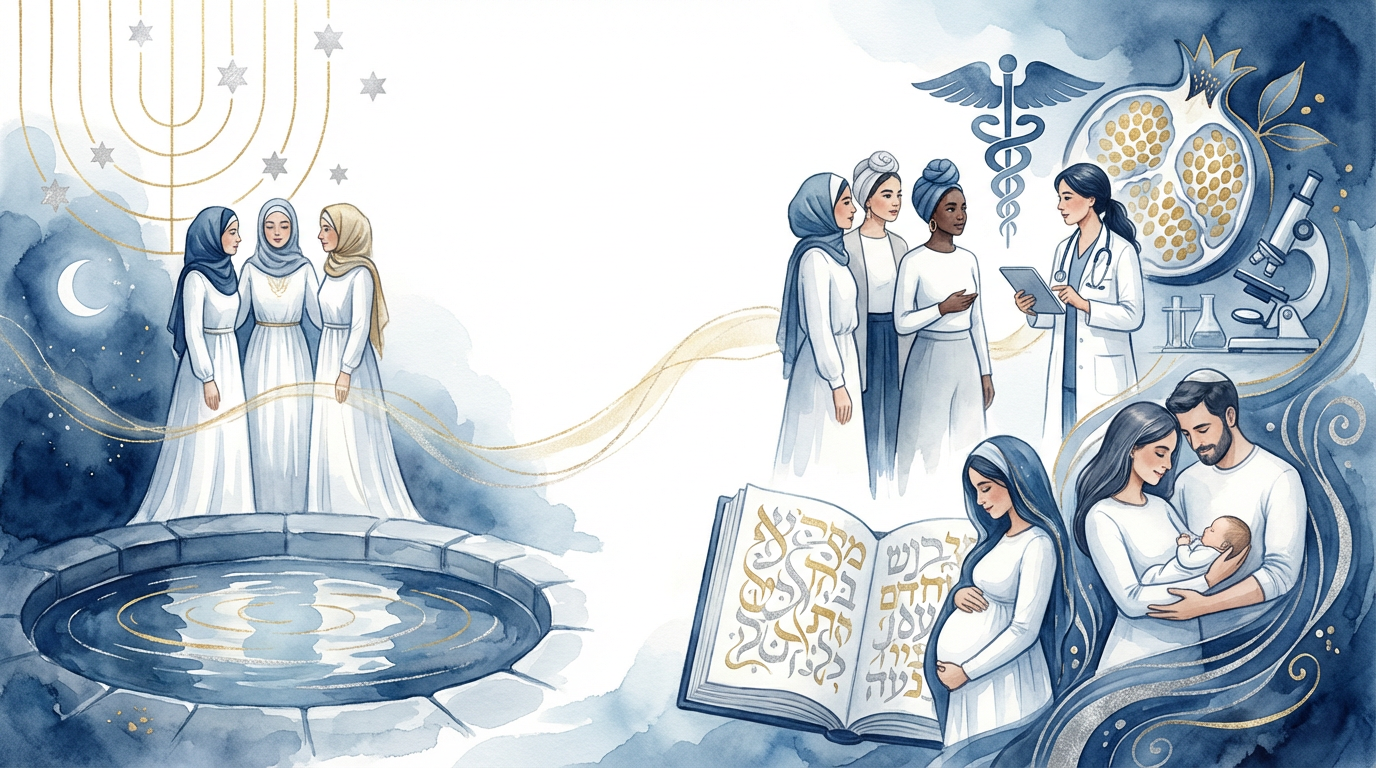
Jewish Fertility Traditions: Mikvah, Niddah & Modern Medicine
Jewish fertility traditions intertwine ancient practices like Mikvah and Niddah with modern reproductive science. This holistic approach supports women navigating family planning and fertility challenges while honoring their faith.
Listen to this article
~13 min listen
Click play to generate audio narration with a calming voice
TL;DR Summary
- •Jewish fertility traditions, particularly Niddah and Mikvah, provide a spiritual framework for intimacy and family building.
- •Integrating these ancient practices with contemporary fertility treatments offers a holistic path for Jewish women navigating reproductive health.
- •Open communication with religious authorities and medical professionals is crucial for harmonizing faith and science in fertility journeys.
Jewish Fertility Traditions: Bridging Ancient Wisdom with Modern Reproductive Science
Jewish fertility traditions offer a rich tapestry of practices and beliefs that profoundly influence family planning and reproductive health. For women balancing career aspirations, family life, and Jewish customs, understanding how ancient laws like Niddah and the spiritual cleansing of Mikvah intersect with modern medicine is essential. This comprehensive guide explores this unique intersection, providing actionable insights for navigating your fertility journey with faith and science hand-in-hand.
What is the Significance of Fertility in Jewish Thought?
Fertility holds immense spiritual and communal significance within Judaism, rooted deeply in foundational texts. The very first commandment given in the Torah, Pru Urvu (Genesis 1:28), instructs humanity to "be fruitful and multiply." This isn't merely a biological imperative but a spiritual one, emphasizing the continuation of the Jewish people and the creation of new life as a partnership with the Divine. Families are seen as the cornerstone of Jewish life, fostering tradition, education, and community.
Beyond procreation, the concept of brit olam (covenant of the world) suggests that each new soul brings unique potential and contributes to the world's perfection. Therefore, the desire for children is often viewed as a sacred yearning, and the challenges of infertility can be particularly poignant within this cultural context. The emphasis on family building means that support for those struggling with fertility is often strong within Jewish communities, encouraging both prayer and proactive medical intervention.
How Does Niddah (Family Purity Laws) Relate to Fertility?
Niddah, often translated as "family purity laws," governs the separation between husband and wife during menstruation and for a period afterward. These laws dictate that a woman becomes niddah (ritually impure) from the onset of her menstrual period until she has counted seven "clean days" and immersed in a mikvah (ritual bath). During the niddah period, physical intimacy, including touch, is prohibited. This practice, often misunderstood, is not about cleanliness but about spiritual status.
From a fertility perspective, Niddah plays a surprisingly direct and indirect role. The counting of seven clean days, often concluding around the time of ovulation for many women, naturally aligns the resumption of intimacy with the most fertile window of the menstrual cycle. This traditional practice, therefore, inherently encourages intercourse during a woman's peak fertile phase, potentially optimizing natural conception. For women with irregular cycles, understanding their individual ovulation patterns in conjunction with Niddah observance can be a powerful tool.
Furthermore, the mandated separation can foster a unique rhythm in a marriage, promoting anticipation, communication, and non-physical intimacy. Some adherents report that the monthly reunion after mikvah immersion reinvigorates their marital bond, bringing a renewed sense of connection and desire. While the primary purpose of Niddah is spiritual, its practical implications for fertility are undeniable.
What is the Role of the Mikvah in Jewish Fertility Journeys?
The Mikvah is a pool of natural water used for ritual immersion, signifying spiritual purification and renewal. For a woman observing Niddah, immersion in the Mikvah marks the culmination of her period of separation and her return to a state of tehorah (ritual purity), allowing intimacy to resume. This act is not merely symbolic; it is considered a transformative spiritual experience.
In the context of fertility, the Mikvah holds profound significance. Many women view their Mikvah night as a powerful moment for prayer and intention, particularly when trying to conceive. It is a time to connect with the Divine, to express hopes for a healthy pregnancy, and to pray for the blessing of children. Some women specifically pray for zera shel kayama (enduring offspring) during their immersion.
Beyond Niddah, the Mikvah can also be used for other life cycle events, including conversions and preparing for marriage. For those undergoing fertility treatments, some women choose to immerse before medical procedures or significant appointments as a spiritual act of preparation and hope. This practice provides emotional and spiritual comfort, helping women feel empowered and connected to their faith during potentially stressful times.
How Do Jewish Law and Ethics Approach Infertility Treatment?
Jewish law (Halakha) generally adopts a highly compassionate and pro-active stance towards infertility. The commandment to Pru Urvu is deeply ingrained, and supporting individuals and couples in fulfilling this mitzvah is paramount. As such, most mainstream Jewish legal opinions permit and even encourage the use of modern fertility treatments, provided they align with specific Halakhic guidelines.
Commonly accepted treatments include:
- •Ovulation Induction: Using medications to stimulate egg production.
- •Intrauterine Insemination (IUI): Placing sperm directly into the uterus.
- •In Vitro Fertilization (IVF): Fertilizing eggs outside the body and transferring embryos to the uterus. IVF is widely accepted, though specific details regarding sperm donation, egg donation, and surrogacy require careful Halakhic consultation.
- •Preimplantation Genetic Diagnosis (PGD) and Screening (PGS): Generally permitted to prevent the transmission of severe genetic diseases, with rabbinic guidance.
Areas requiring careful rabbinic consultation include:
- •Sperm Donation: While generally permissible for the purpose of procreation, concerns exist regarding lineage, paternity, and the identity of the child for religious purposes. Some rabbinic authorities permit it under specific circumstances, often with non-Jewish donors, to avoid issues of incest if the child were to marry a close relative of the donor.
- •Egg Donation: More widely accepted than sperm donation, as Jewish law typically follows the birth mother for maternal lineage. However, questions can arise regarding the spiritual mother and potential genetic connections.
- •Surrogacy: Gestational surrogacy (where the surrogate is not genetically related to the child) is generally preferred over traditional surrogacy. Complex Halakhic questions arise regarding who is considered the mother (genetic, gestational, or rearing mother), requiring explicit rabbinic guidance.
- •Embryo Freezing and Storage: Permitted, but concerns exist about the status of frozen embryos and the ethical considerations of their disposal or donation.
Open and honest dialogue with a knowledgeable rabbi or Halakhic authority is crucial when considering any fertility treatment, especially those involving third-party reproduction. These discussions ensure that medical decisions align with one's religious convictions and family values.
Can Jewish Women Harmonize Niddah with Fertility Tracking and Treatments?
Absolutely. Harmonizing Niddah with modern fertility tracking and treatments is a common and achievable goal for many Jewish women. It requires careful planning, communication, and often, the guidance of both a fertility specialist and a Halakhic advisor (such as a rabbi or a yoetzet Halakha – a female advisor on Jewish law).
Strategies for harmonization include:
- •Ovulation Tracking: Using methods like Basal Body Temperature (BBT) charting, ovulation predictor kits (OPKs), and cervical mucus monitoring can help identify the fertile window. This information is then used to time Mikvah immersion to coincide with or immediately precede ovulation.
- •Timing Mikvah Immersion: For women with regular cycles, the Mikvah night often naturally falls around ovulation. For those with irregular cycles or who ovulate earlier, a Halakhic dispensation may be sought to shorten the Niddah period (e.g., by starting the seven clean days earlier) to ensure intimacy can resume during the fertile window. This is a common practice when actively trying to conceive.
- •Medical Intervention and Niddah: Fertility medications can be used to regulate ovulation, ensuring it occurs after Mikvah immersion. For procedures like IUI or IVF, timing is critical. Rabbinic guidance is often sought to ensure that sperm collection and procedures align with Niddah laws, especially regarding the prohibition of hashchatat zera (wasting of seed) outside of procreative acts. Often, a heter ( Halakhic permission) is given for specific methods of sperm collection for fertility treatments.
- •Communication with Medical Staff: Informing your fertility doctor about your religious observances can help them tailor treatment plans. Many clinics are experienced in working with observant Jewish patients and can adjust schedules for procedures or appointments to accommodate Shabbat, Jewish holidays, and Mikvah timing.
- •Yoetzet Halakha: Consulting a yoetzet Halakha is invaluable. These are highly trained women who provide guidance on Halakha related to women's health, Niddah, and fertility. They can offer practical advice, help navigate complex situations, and connect women with rabbinic authorities when necessary.
This integration allows women to pursue their dream of building a family while fully upholding their spiritual commitments, transforming potential conflicts into opportunities for deeper faith and purpose.
What Support Systems Exist for Jewish Women Navigating Fertility Challenges?
Navigating fertility challenges can be emotionally, physically, and spiritually taxing. Fortunately, within Jewish communities, robust support systems have emerged to address these unique needs.
- •Rabbis and Yoatzot Halakha: As mentioned, these religious guides offer Halakhic expertise and spiritual counseling, helping couples integrate their faith into their fertility journey. They can provide emotional support and connect individuals to resources.
- •Community Organizations: Numerous non-profit organizations are dedicated to supporting Jewish couples facing infertility. Examples include:
- •Puah Institute: A globally recognized organization that provides Halakhic guidance, medical referrals, and emotional support for all aspects of fertility and genetics within Jewish law. They offer a hotline, counseling, and financial assistance.
- •A Time: Offers comprehensive services including medical referrals, emotional support, financial aid, advocacy, and educational resources.
- •Bonei Olam: Focuses on providing financial assistance for fertility treatments, ensuring that cost is not a barrier to building a Jewish family.
- •Support Groups: Many of these organizations, as well as local synagogues and community centers, facilitate support groups where women can share experiences, receive empathy, and feel less isolated. These groups often acknowledge the unique pressures and sensitivities of infertility within a religious context.
- •Family and Friends: Close family and friends, when approached with sensitivity and understanding, can offer invaluable emotional and practical support. It's important to communicate your needs clearly to those you trust.
- •Spiritual Practices: Beyond Mikvah, engaging in personal prayer, studying relevant Jewish texts, and participating in communal prayer can provide comfort, strength, and a sense of connection to a larger purpose during challenging times.
These multifaceted support systems ensure that Jewish women do not have to face their fertility journeys alone, providing a network of care that addresses their medical, emotional, and spiritual needs.
Key Takeaways
- •Jewish tradition places high value on fertility and family, viewing procreation as a sacred commandment.
- •Niddah laws, including Mikvah immersion, can naturally align with the fertile window, supporting natural conception.
- •Jewish law generally permits and encourages modern fertility treatments, with specific ethical guidelines for complex procedures.
- •Harmonizing religious observance with fertility tracking and treatments is possible through careful planning and expert guidance.
- •Robust support systems, including rabbinic advice, yoatzot Halakha, and specialized organizations, are available for Jewish women navigating fertility challenges.
Frequently Asked Questions
Q: Is IVF permitted in Jewish law?
A: Yes, In Vitro Fertilization (IVF) is generally permitted and often encouraged by Jewish law, as it helps fulfill the commandment of Pru Urvu (be fruitful and multiply). However, specific aspects like sperm collection, egg/sperm donation, and surrogacy require careful consultation with a knowledgeable rabbi or Halakhic authority to ensure adherence to Jewish ethical guidelines.
Q: Can I shorten my Niddah period to time Mikvah with ovulation?
A: In many cases, yes. For women actively trying to conceive or undergoing fertility treatments, rabbinic authorities may provide dispensations to shorten the Niddah period, particularly by allowing the counting of the seven "clean days" to begin earlier. This ensures that intimacy can resume during the fertile window. It is crucial to consult with a yoetzet Halakha or rabbi for personalized guidance.
Q: What is a yoetzet Halakha and how can she help with fertility?
A: A yoetzet Halakha is a highly trained female advisor on Jewish law, particularly concerning women's health, Niddah, and family purity. She can provide practical advice, answer complex questions, offer emotional support, and help bridge the gap between medical treatments and Halakhic observance. She can also guide you on timing Mikvah immersion with ovulation and connect you with rabbinic authorities for specific Halakhic rulings.
Q: Are there specific prayers or rituals for fertility in Judaism?
A: While there isn't one universal ritual, many Jewish women engage in personal prayer, particularly during Mikvah immersion, to ask for the blessing of children. Praying at holy sites, reciting Psalms, and making charitable donations (tzedakah) are also common practices. Some communities have special prayers recited for those struggling with infertility.
Q: How do Jewish communities support couples facing infertility?
A: Jewish communities offer extensive support. This includes guidance from rabbis and yoatzot Halakha, specialized non-profit organizations (like Puah Institute, A Time, Bonei Olam) that provide medical referrals, financial assistance, and emotional support, and local support groups. The strong communal emphasis on family building ensures a network of care.
Q: What if my fertility doctor is not familiar with Jewish customs?
A: It's important to communicate openly with your fertility doctor about your religious observances. Many clinics, especially in areas with significant Jewish populations, are familiar with these needs. If your doctor is unfamiliar, you can explain your requirements (e.g., timing of intimacy, need for Halakhic sperm collection methods) or seek advocacy from organizations like Puah Institute, which can liaise with medical professionals on your behalf.
Q: Does Jewish law have views on freezing eggs or embryos?
A: Freezing eggs (oocyte cryopreservation) and embryos is generally permitted within Jewish law for future procreation. However, the ethical considerations surrounding the long-term storage, potential disposal, or donation of frozen embryos are complex and require careful rabbinic consultation to ensure adherence to Halakhic principles regarding the sanctity of potential life.
Start Your Wellness Journey Today
Ready to track your cycle, fertility, pregnancy, or menopause journey? Download PERIODiQ - your iQ-powered wellness companion designed for every stage of your health journey.
Get PERIODiQ Free: https://periodiq.app
Your Wellness Journey Starts Here
Download PERIODiQ
Scan the QR code or tap the link to get started with your personalized health tracking.
periodiq.app • iOS & Android
Cite this article
PERIODiQ Editorial Team (2026). "Jewish Fertility Traditions: Mikvah, Niddah & Modern Medicine." PERIODiQ. https://periodiq.app/library/jewish-fertility-traditions-mikvah-niddah-modern-medicine
"Jewish Fertility Traditions: Mikvah, Niddah & Modern Medicine." PERIODiQ, 2026, https://periodiq.app/library/jewish-fertility-traditions-mikvah-niddah-modern-medicine.
Send this to a friend — PERIODiQ is free for them too. No card. No paywall.
Loved this? Save articles, track your cycle, and unlock meditations — free forever.
Disclaimer: PERIODiQ™ offers general wellness information only. It does not provide medical advice, diagnosis, or treatment. Always speak with a licensed health professional about your health.