
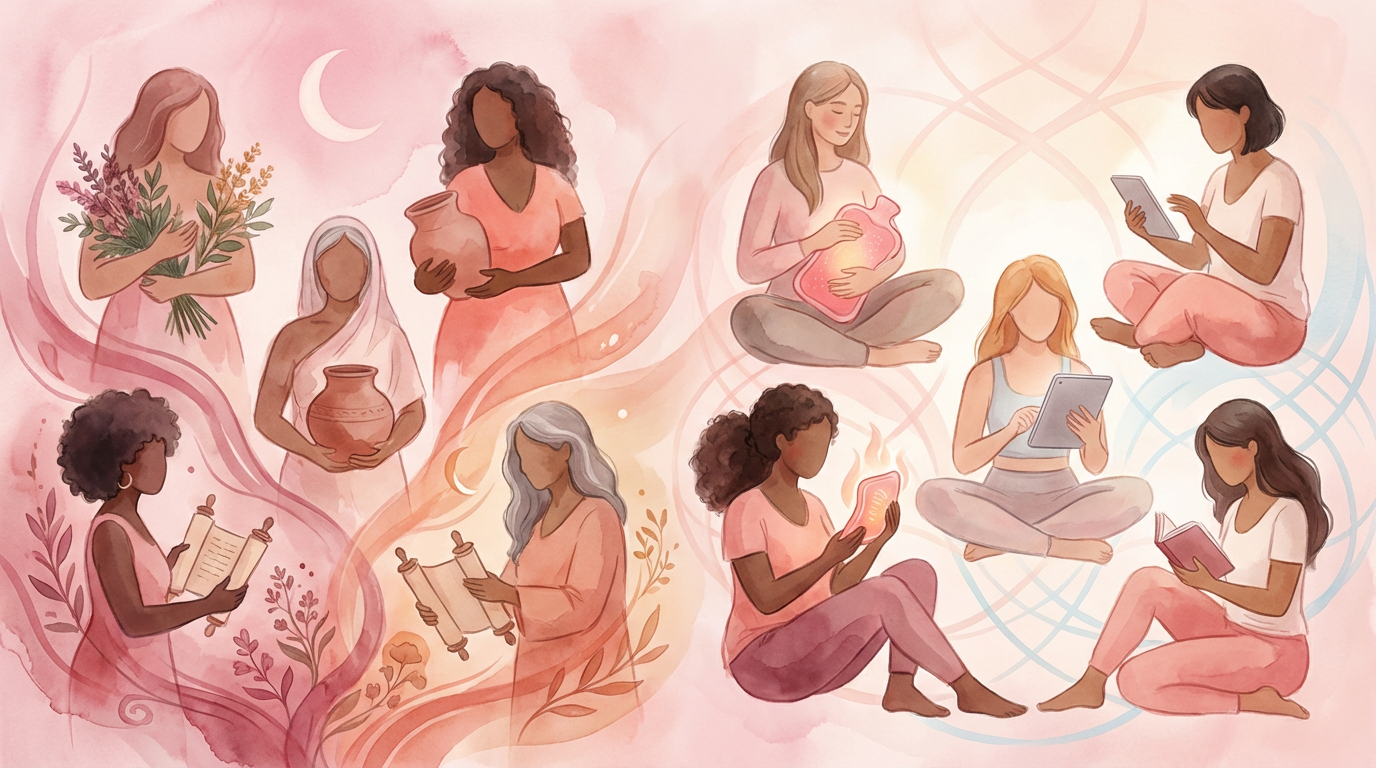
History of Period Pain Management: Ancient Remedies to Modern Solutions
Explore how women have managed menstrual pain throughout history, from ancient herbal remedies to today's medical advances.
Listen to this article
~16 min listen
Click play to generate audio narration with a calming voice
History of Period Pain Management: Ancient Remedies to Modern Solutions
Throughout human history, women have sought relief from menstrual pain. While our understanding of the menstrual cycle has evolved dramatically, the quest for comfort during menstruation remains universal. This journey through time reveals how cultural attitudes, medical knowledge, and treatment approaches have transformed—and what wisdom we can still draw from the past.
Ancient Civilizations: The First Remedies
Ancient Egypt (3000 BCE - 30 BCE)
Egyptian medical papyri, some of the oldest medical texts in existence, contain prescriptions for menstrual discomfort. The Ebers Papyrus recommends a mixture of honey, acacia leaves, and dates applied as a poultice to the lower abdomen. Honey's antibacterial properties and acacia's anti-inflammatory compounds suggest these remedies had genuine therapeutic value beyond placebo.
Women also used heat therapy—warm bricks wrapped in cloth placed on the abdomen—a practice still effective today.
Ancient Greece and Rome (800 BCE - 476 CE)
Hippocrates, the father of medicine, wrote extensively about "hysteria"—a catch-all diagnosis that included menstrual complaints. His treatments included herbal infusions of willow bark (containing salicin, the precursor to aspirin), fennel, and parsley.
Roman physician Soranus of Ephesus was more progressive, recognizing that menstrual pain was a legitimate physical condition rather than hysteria. He recommended rest, warm baths, gentle massage, and dietary modifications—approaches that align with modern self-care recommendations.
Ancient China and India
Traditional Chinese Medicine viewed menstrual pain as a result of qi (energy) and blood stagnation. Treatments included acupuncture, moxibustion (burning herbs near specific points), and herbal formulas containing ingredients like dong quai, ginger, and cinnamon.
In Ayurvedic medicine, menstrual pain was attributed to an imbalance of doshas. Practitioners prescribed turmeric (a powerful anti-inflammatory), fenugreek, and specific yoga poses designed to improve pelvic circulation.
Medieval and Renaissance Period (500 - 1600 CE)
The Dark Ages of Women's Health
Medieval Europe saw menstruation become heavily stigmatized due to religious doctrine. Women were often considered "unclean" during menstruation, leading to social isolation that ironically may have provided rest—perhaps inadvertently beneficial.
Medical understanding stagnated, with many remedies based on superstition rather than observation. However, herbalists and midwives continued to pass down knowledge of medicinal plants:
- •Mugwort: Used to regulate cycles and ease cramps
- •Chamomile: For its calming and anti-inflammatory properties
- •Yarrow: To reduce heavy bleeding and pain
Renaissance Revival
The Renaissance brought renewed interest in anatomy and medicine. While menstruation itself remained poorly understood, physicians began documenting patterns and symptoms more systematically. Leonardo da Vinci's anatomical drawings included detailed depictions of female reproductive organs, though full understanding of their function remained elusive.
The 18th and 19th Centuries: Medical Progress and Misguided "Cures"
The Age of Bloodletting and Laudanum
Victorian-era physicians prescribed some truly alarming treatments:
- •Bloodletting: The irony of using blood loss to treat symptoms partly caused by blood loss was lost on many practitioners
- •Laudanum (Opium Tincture): While effective for pain, highly addictive
- •Bed Rest Cure: Women were confined to bed for weeks, allegedly to preserve feminine energy
- •Hysterectomy: In extreme cases, surgical removal of the uterus was considered appropriate for "hysteria"
Botanical Medicine Persists
Despite questionable medical practices, traditional herbal remedies remained popular:
- •Cramp Bark: Named specifically for its antispasmodic properties
- •Black Cohosh: Used to balance hormones
- •Raspberry Leaf: To tone the uterus and reduce cramping
The 20th Century: Scientific Understanding Emerges
Early 1900s: Hormones Discovered
The discovery of hormones in the early 20th century revolutionized understanding of menstruation. Scientists identified estrogen and progesterone, finally explaining the biological mechanisms behind the menstrual cycle.
This led to the first hormone-based treatments, though early formulations were crude and had significant side effects.
1950s-1960s: The Birth Control Pill
The development of the oral contraceptive pill in the 1960s was transformative—not just for family planning, but for menstrual pain management. Women could finally control their cycles, reduce flow, and alleviate cramps.
1970s-1980s: NSAIDs Revolution
The discovery that prostaglandins cause menstrual cramps led to targeted treatments. Ibuprofen, approved for over-the-counter use in the 1980s, provided effective relief by inhibiting prostaglandin production.
This was a watershed moment: menstrual pain was finally recognized as having a specific, treatable biological cause.
1990s-Present: Diverse Treatment Options
Modern women have unprecedented options:
- •Hormonal contraceptives: Pills, patches, rings, IUDs
- •NSAIDs: Targeted anti-inflammatory medications
- •Physical therapy: Pelvic floor therapy for chronic pain
- •TENS units: Portable electrical stimulation for pain relief
- •Integrative medicine: Combining conventional and complementary approaches
Cultural Perspectives and Menstrual Practices
Varied Cultural Traditions
Different cultures developed unique approaches:
- •Japan: Emphasis on warm baths (onsen) and specific foods during menstruation
- •Native American: Moon lodges where women gathered during menstruation for rest and support
- •African traditions: Various herbal remedies passed down through generations
- •Latin American: Teas made from herbs like oregano and cinnamon
The Stigma Factor
Throughout history, cultural attitudes toward menstruation have profoundly affected treatment. When menstruation was shameful or taboo, women suffered in silence. Modern menstrual equity movements are working to end period poverty and stigma, recognizing that access to pain relief is a health equity issue.
What Modern Women Can Learn from History
Timeless Wisdom That Still Works:
Heat Therapy: Ancient Egyptian warm bricks to modern heating pads—heat relieves cramping by relaxing uterine muscles and improving blood flow.
Herbal Medicine: Many traditional remedies have proven anti-inflammatory and antispasmodic properties. Ginger, turmeric, and chamomile tea remain effective complementary treatments.
Rest and Self-Care: Cultures that encouraged rest during menstruation recognized something important—chronic pain requires recovery time.
Community Support: Historical practices like moon lodges highlight the value of shared experience and mutual support during menstruation.
What We've Left Behind (Thankfully):
- •The notion that menstrual pain is psychological or exaggerated
- •Dangerous treatments like bloodletting or unregulated drugs
- •Social isolation and shame around menstruation
- •The idea that women should simply "endure" pain
The Future of Menstrual Pain Management
Research continues to advance:
- •Better understanding of endometriosis and PCOS
- •Development of targeted therapies with fewer side effects
- •Personalized medicine approaches based on genetics
- •Wearable technology for tracking and predicting symptoms
- •Increased research funding as menstrual health gains recognition
Conclusion: Honoring the Past, Embracing the Future
The history of period pain management is a testament to women's resilience and ingenuity. From Egyptian honey poultices to modern NSAIDs, the quest for relief has driven innovation across millennia.
Today, we have the best of all eras: scientific understanding, effective medications, evidence-based complementary therapies, and growing social acceptance. We stand on the shoulders of countless women who advocated for better treatments and the healers who developed them.
Your menstrual pain deserves attention, respect, and effective treatment. You are part of this long history—and the future looks brighter than ever.
Disclaimer: PERIODiQ™ offers general wellness information only. It does not provide medical advice, diagnosis, or treatment. Always speak with a licensed health professional about your health.
Cite this article
PERIODiQ Editorial Team (2025). "History of Period Pain Management: Ancient Remedies to Modern Solutions." PERIODiQ. https://periodiq.app/library/history-period-pain-management
"History of Period Pain Management: Ancient Remedies to Modern Solutions." PERIODiQ, 2025, https://periodiq.app/library/history-period-pain-management.
Send this to a friend — PERIODiQ is free for them too. No card. No paywall.
Loved this? Save articles, track your cycle, and unlock meditations — free forever.
Disclaimer: PERIODiQ™ offers general wellness information only. It does not provide medical advice, diagnosis, or treatment. Always speak with a licensed health professional about your health.